
Ink Category
TrueHue Reactive Textile Inks
Reactive inks are fixed by forming a chemical bond with cellulosic fibres such as cotton, linen and viscose. The bond makes the colour part of the fibre; the process includes pre-treatment, steaming and washing.
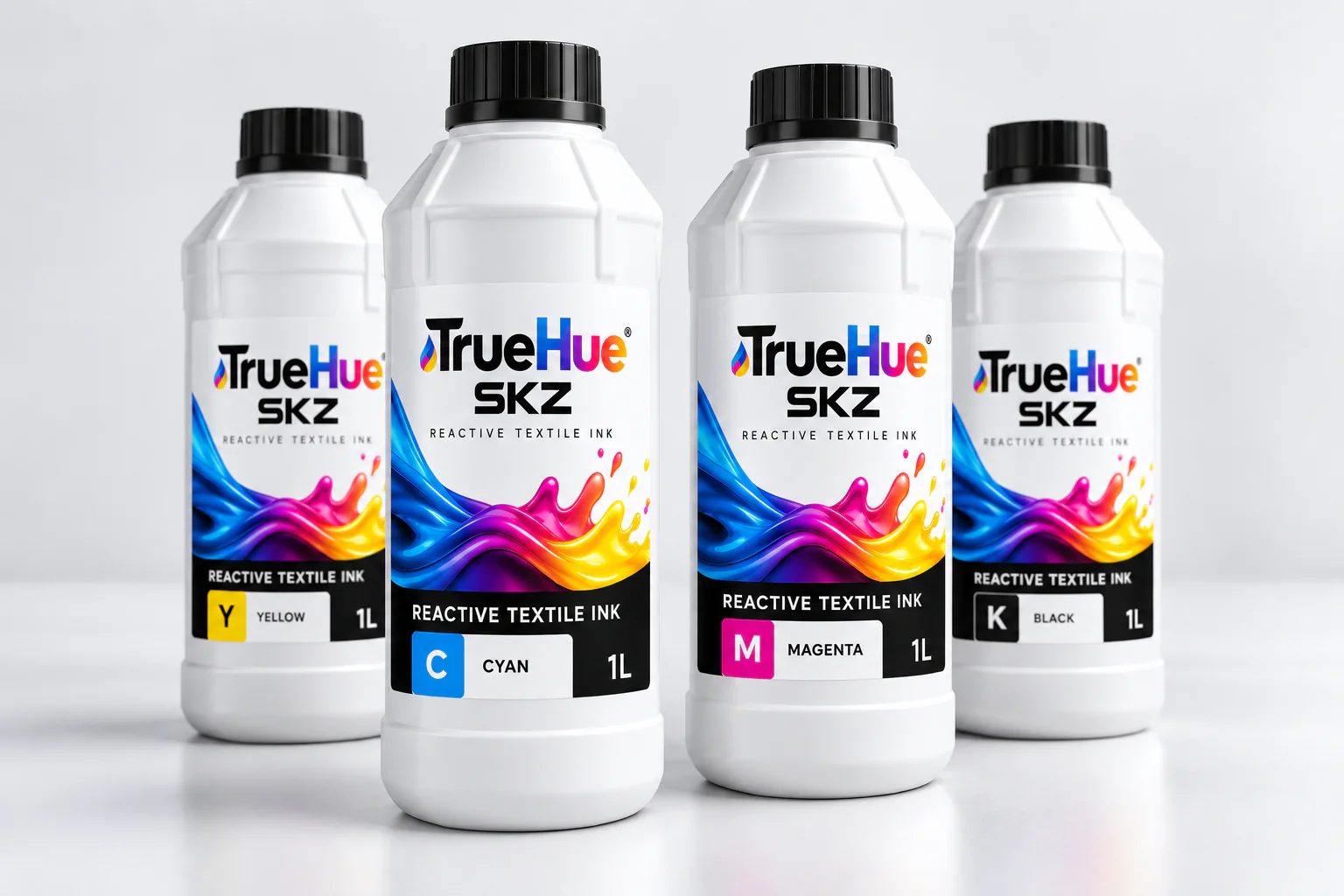

- Ink family
- TrueHue
- Category
- Reactive Textile
- Print medium
- Cellulosic fabric
01 / About the Ink
What is reactive ink
In reactive ink the dye molecule forms a chemical bond with cellulosic fibres. The class is therefore preferred on fibres such as cotton, linen and viscose; acid systems are considered for protein fibres and disperse systems for synthetic fibres.
Before printing, the fabric undergoes a pre-treatment that supports the reaction and print sharpness. After printing, steaming allows the bond to form and washing removes the dye that has not bonded.
Because steaming and washing require extra equipment and process steps, the choice depends on the equipment already in the production line and the target fabric hand feel. The ink is assessed together with machine, print head, pre-treatment and steaming conditions.
02 / Applications
Applications
- 01
Cotton fabrics
Pattern prints on fashion and apparel fabrics.
- 02
Viscose and linen
Print applications on viscose and linen based fabrics.
- 03
Home textiles
Bed linen, tablecloths and decorative cellulosic fabrics.
- 04
Scarves and shawls
Scarf and accessory prints on fine cellulosic fabrics.
Pre-treatment, steaming and washing conditions are verified with a test print on each fabric.
03 / Process
The ink's place in the process
- 01Pre-Treatment
Pre-treatment
A pre-treatment that supports the reactive dye reaction is applied to the fabric.
- 02Printing
Printing
The pattern is printed onto the fabric with reactive ink.
- 03Steaming
Steaming
Under steam the dye forms a chemical bond with the fibre.
- 04Washing
Washing
Unbonded dye and chemicals are removed by washing.
Pre-treatment chemicals, steaming time and washing conditions are determined by the fabric and the ink series.
04 / Related Equipment
Related Machines and Equipment
These pages show the machines and process equipment associated with this ink category. Compatibility is not determined by the ink alone; machine configuration, print head and process conditions are assessed together.
- 01View the equipment
Reactive Textile
- 02View the equipment
Pre-Treatment Padding Machine
05 / Knowledge Center
Ink Guide
- 01
The Key Differences Between Pigment and Reactive Ink
Pigment ink holds the dye on the fabric surface with a binder film, while reactive ink chemically bonds the dye molecule to the cellulosic fiber; this difference sets the two methods' fixation process and required production steps apart.
Read the guide - 02
How Is Ink-Machine Compatibility Evaluated?
Ink-machine compatibility is the evaluation, both before and after installation, of whether a given ink series will run smoothly with a machine's print head and feeding system.
Read the guide